Does Induction Use Less Electricity Than Solid Plate, and Does It Really Reduce Total Cost of Ownership?
Table of Contents
Quick Answer
Induction cookers usually consume less electricity because heat is generated directly in the cookware. However, lower electricity consumption does not always mean lower total cost of ownership. For distributors, the better choice depends on purchase price, cookware compatibility, electricity rates, maintenance requirements and target market conditions.
Introduction
If you source electric cookers for wholesale or distribution, you already know the questions buyers ask most often: How much power does it draw? What will the running cost look like over a year?
The deeper question that drives purchasing decisions is usually this: Will the energy savings justify the higher purchase price? This question is especially important when choosing products for different markets with different electricity prices, customer expectations and service conditions.
After years of working with kitchen appliance manufacturers and overseas buyers, this challenge appears frequently when distributors compare efficiency, pricing, market suitability and long-term value. Rated efficiency, however, is not the same as actual operating cost or commercial value.
While induction cookers generally offer higher energy efficiency, solid plate cookers may still provide better overall value in markets where affordability, durability, service availability and customer acceptance are more important than maximum energy savings.
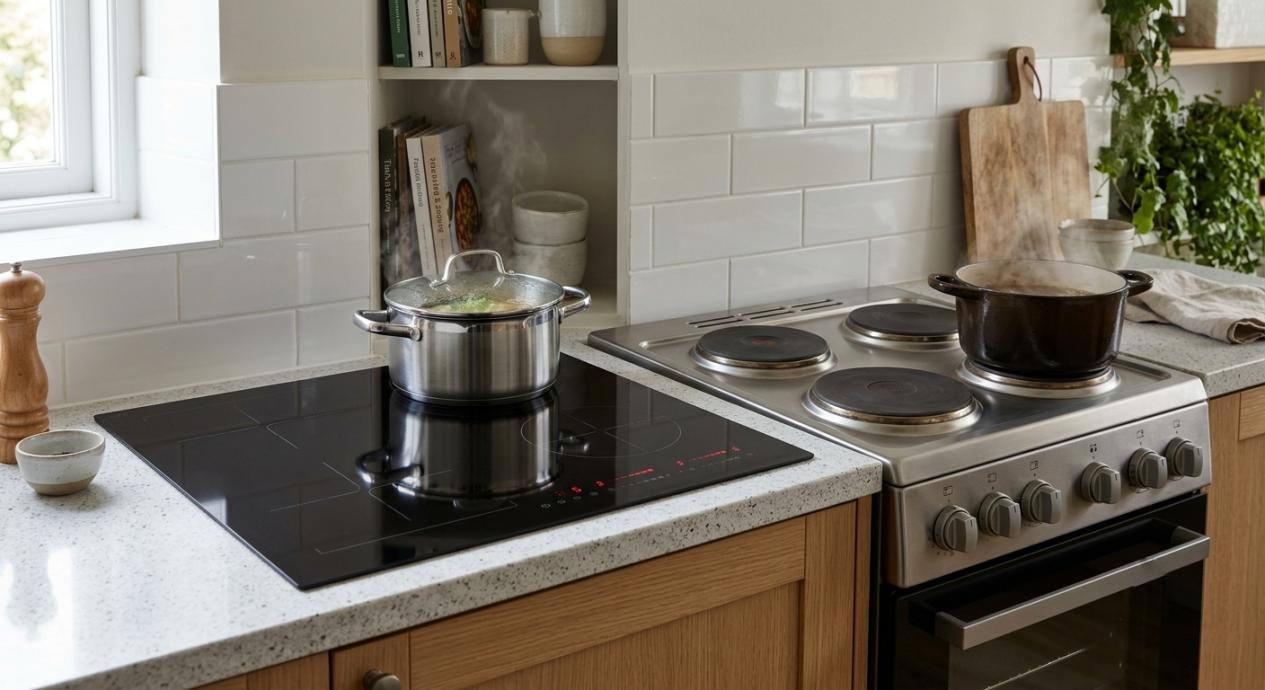
What Is the Difference Between Induction and Solid Plate Cookers?
Understanding the basic technology helps distributors explain product differences, position pricing and avoid recommending the wrong solution for different markets.
These differences directly influence selling price, customer expectations and after-sales requirements.
How Does an Induction Cooker Work?
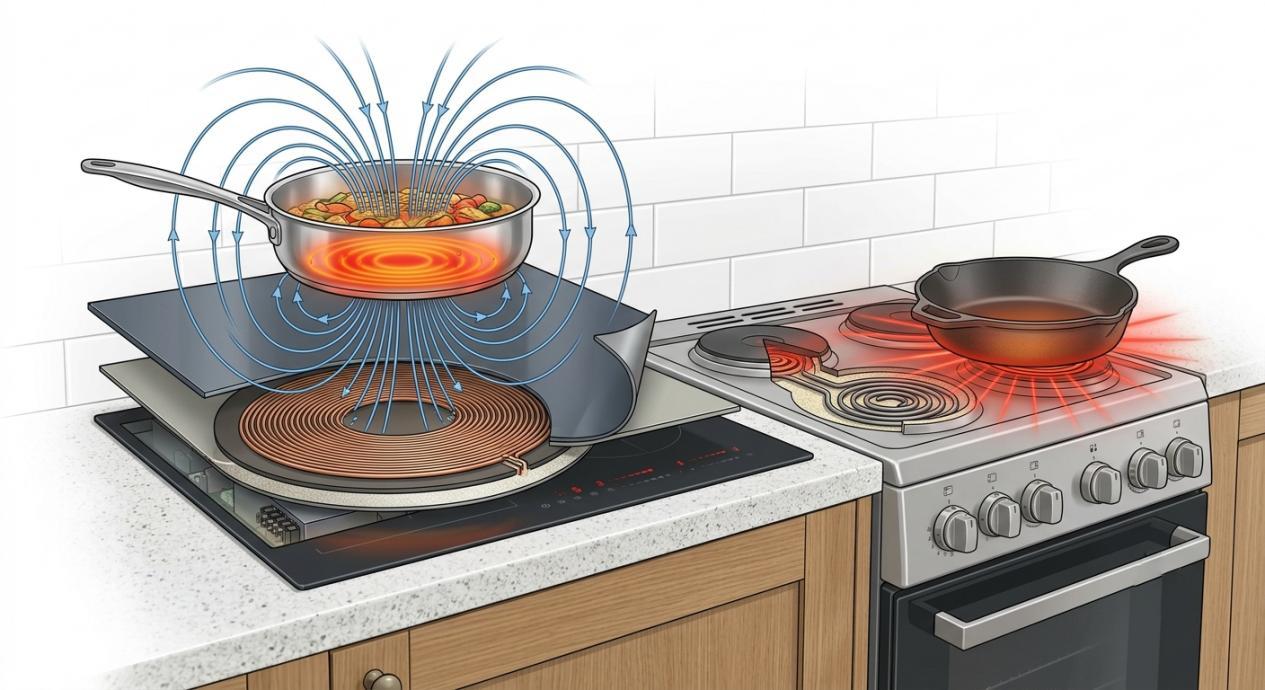
An induction cooker uses electromagnetic induction. A coil beneath the glass surface creates a magnetic field that induces electric currents directly in the base of ferromagnetic cookware. The pan itself becomes the heat source. Heat transfers almost immediately into the food, and very little energy escapes into the surrounding air or the cooker body.
Because heat is generated directly in the cookware, less energy is lost to the surrounding environment. For distributors, this efficiency advantage allows induction cookers to be positioned as premium, energy-efficient electric cookers in markets where customers value lower operating costs and modern kitchen technology.
How Does a Solid Plate Cooker Work?
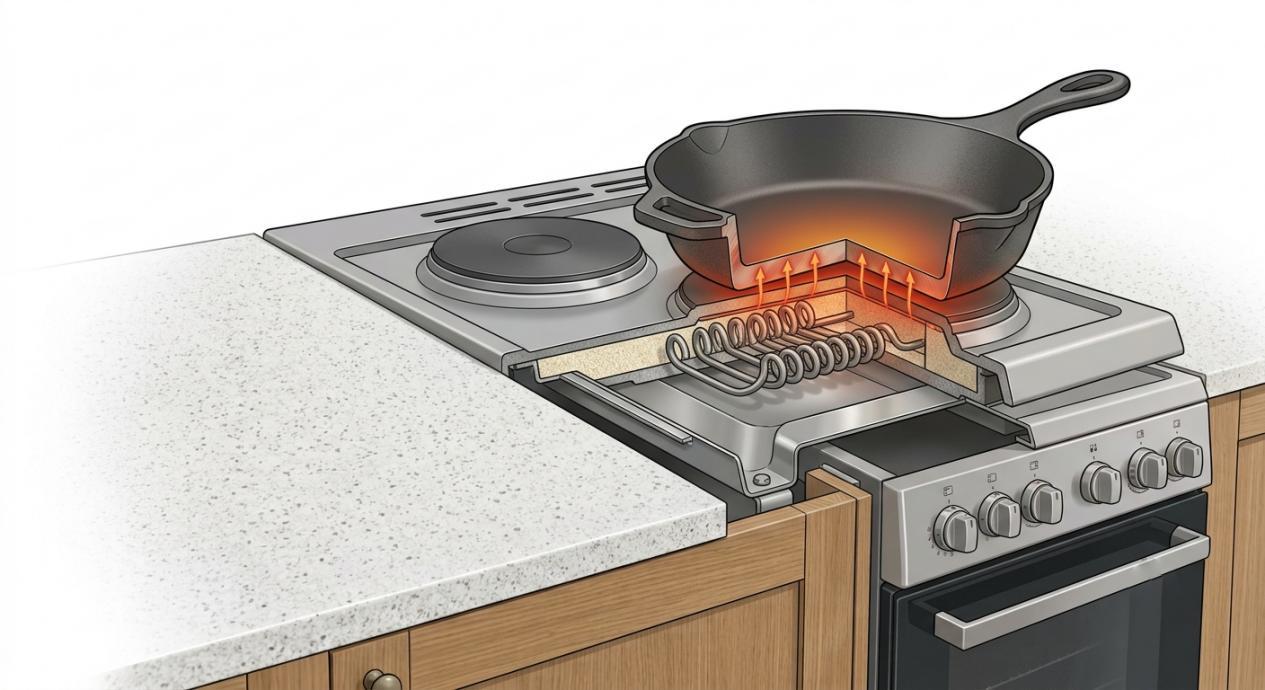
A solid plate cooker relies on traditional electric resistance heating. An element under a cast-iron or metal plate generates heat, and that heat transfers by conduction to the bottom of the cookware. After you switch the unit off, residual heat remains in the plate for several minutes.
The structure is simple. There are fewer electronic components, heating is stable once the plate reaches temperature, and repairs are usually straightforward. This makes solid plate cookers suitable for markets where repair accessibility and long-term reliability are more important than maximum energy efficiency.
Does Induction Use Less Electricity Than Solid Plate?
Yes, generally induction consumes less electricity because heat transfer is more efficient. Induction technology is generally recognized for higher heat-transfer efficiency than traditional resistance heating because energy is generated directly in the cookware.
| Factor | Induction | Solid Plate | Business Meaning |
|---|---|---|---|
| Heating method | Electromagnetic | Resistance heating | Determines energy transfer |
| Energy transfer | Direct | Indirect | Influences running cost |
| Heat loss | Lower | Higher | Affects electricity use |
| Heating speed | Faster | Slower | Influences user experience |
Lower energy consumption does not automatically mean lower total cost of ownership. Power ratings on the nameplate are only one part of the equation.
Does a Higher Wattage Mean Higher Electricity Consumption?
A 2000 W rating does not mean the cooker constantly draws 2000 W. Actual electricity use depends on working time, temperature control precision and overall efficiency. Induction often reaches the target temperature faster and may reduce overall cooking time, which can lower total energy use. For sourcing decisions, electric cooker wattage is less important than expected real-world electricity consumption under local usage conditions.
How Much Electricity Does an Induction Cooker Use Compared With a Solid Plate Cooker?
You can estimate electricity use with a simple formula:
Power (kW) × Usage time (hours) × Electricity rate.
Take a typical 2000 W electric cooker as a simple example. If it runs one hour per day:
2 kW × 1 hour × 365 days = 730 kWh per year.
This example shows rated consumption only. Actual electricity use depends on cooking behavior, power settings and operating efficiency. In practice, induction often reaches cooking temperature faster, so the actual daily running time can be shorter. Solid plate models may stay on longer because heat builds more slowly.
For distributors, annual energy consumption estimates are more meaningful than rated power alone because they reflect actual customer usage. Understanding induction vs solid plate power consumption in real conditions helps avoid over-promising savings to retailers.
Why Does Higher Energy Efficiency Not Always Mean Lower Total Cost?
This is the core question that separates a good product decision from an expensive one.
Does Cookware Affect Induction Cooker Energy Savings?
Induction requires magnetic (ferromagnetic) cookware. Aluminium, copper or glass pans will not work unless they have a special magnetic base. In markets where households already own large amounts of non-magnetic cookware, the switch creates extra cost and friction.
You may need to educate retailers, provide compatible starter sets, or accept returns when customers discover the limitation. Solid plate cookers work with almost any flat-bottomed pot or pan. Induction cookware compatibility is not only a technical specification but also a customer adoption factor and switching cost that can offset the energy savings on paper.
How Do Electricity Prices Affect the Value of Energy Efficiency?
The financial benefit of induction depends heavily on local electricity prices and cooking frequency. A simple payback calculation helps:
Payback Period = Additional Induction Cost ÷ Annual Energy Savings
In high-tariff regions the lower kWh consumption of an energy-efficient electric cooker pays back the higher purchase price more quickly. In markets with low electricity costs, the difference in running cost becomes smaller and the initial investment carries more weight. This helps distributors explain the price difference using measurable business value instead of product specifications alone.
Do Maintenance Costs Change the Long-Term Cost Difference?
Induction systems may involve more complex electronic components, which can increase repair complexity when failures occur. Solid plate cookers have a simpler mechanical structure. Many common faults can be fixed by local technicians with basic tools, and replacement components are often simpler and easier to source.
For wholesale buyers, this translates into different levels of warranty risk and after-sales pressure. In regions where service networks are limited, the durability and easy maintenance of solid plate models often outweigh the efficiency advantage of induction.
How Should Distributors Compare the Total Cost of Ownership?
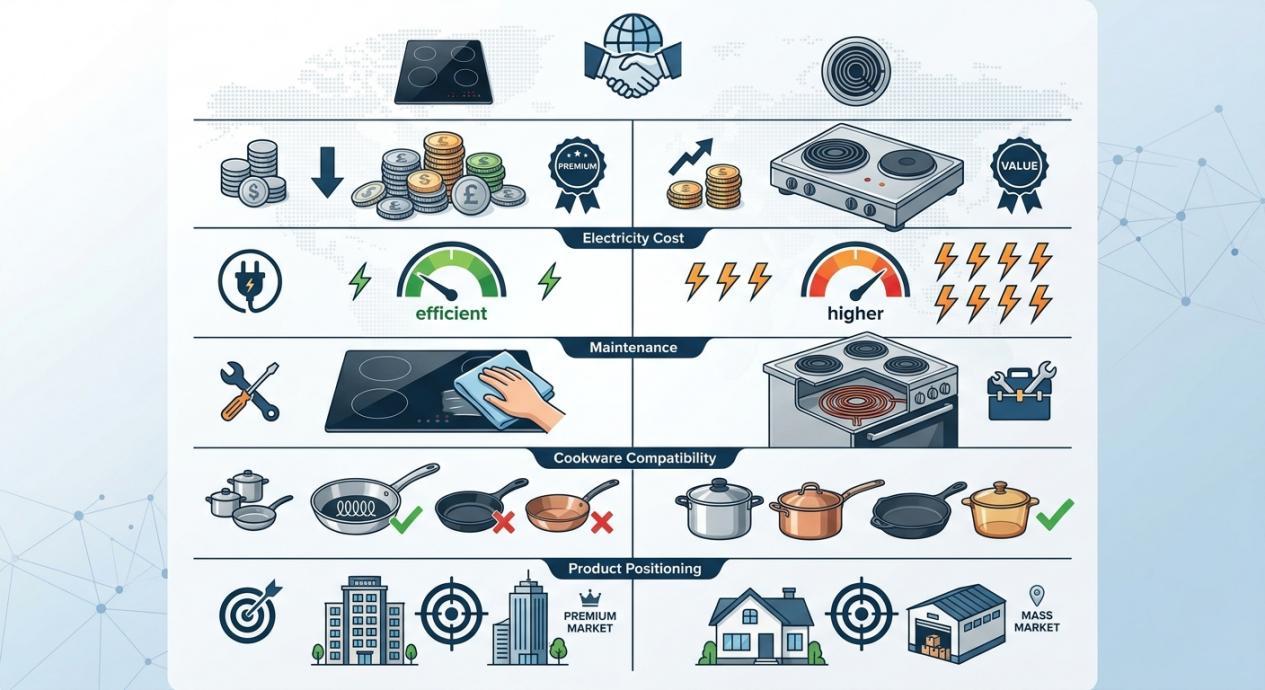
Total Cost of Ownership includes purchase price, electricity cost, maintenance, replacement risk and customer acceptance. Looking only at energy efficiency gives an incomplete picture when evaluating different electric cooker options.
| Cost Factor | Induction | Solid Plate | Business Impact |
|---|---|---|---|
| Initial investment | Higher | Lower | Market entry |
| Energy cost | Lower | Higher | Operating expense |
| Maintenance | More complex | Simpler | Warranty risk |
| Cookware compatibility | Limited | Universal | Customer adoption |
| Positioning | Premium | Value | Target segment |
Quick Decision Guide for Distributors
| Business Priority | Better Choice |
|---|---|
| Premium positioning | Induction |
| High electricity cost markets | Induction |
| Lowest running cost | Induction |
| Lowest purchase cost | Solid Plate |
| Easy maintenance | Solid Plate |
| Universal cookware compatibility | Solid Plate |
In many mid- and low-income markets the solid plate option still delivers lower total cost of ownership for the end user and lower commercial risk for the distributor. In premium markets the opposite is often true.
Which Is Better for Wholesale Business: Induction or Solid Plate Cooker?
When Should Distributors Choose Induction Cookers?
Induction is often the stronger choice for premium segments in markets such as Europe, North America and Australia, where customers place higher value on speed, precise control, modern appearance and lower energy bills. Depending on the destination market, buyers may require certifications such as CE, EMC or other local compliance approvals. Positioning the product as an energy-efficient electric cooker supports higher margins. Working with a reliable electric cooker supplier with induction expertise helps match specifications and packaging to local expectations.
When Should Distributors Choose Solid Plate Cookers?
Solid plate models remain highly competitive in many price-sensitive markets across Africa, the Middle East and Southeast Asia, as well as in rental housing, social housing projects and budget hotels. Customers prioritise affordability, reliability and the ability to use existing cookware. The simpler design also reduces after-sales pressure. An affordable electric cooker that lasts and is easy to repair often outperforms a more efficient but more expensive alternative in these segments.
Should Distributors Offer Both Induction and Solid Plate Cookers?
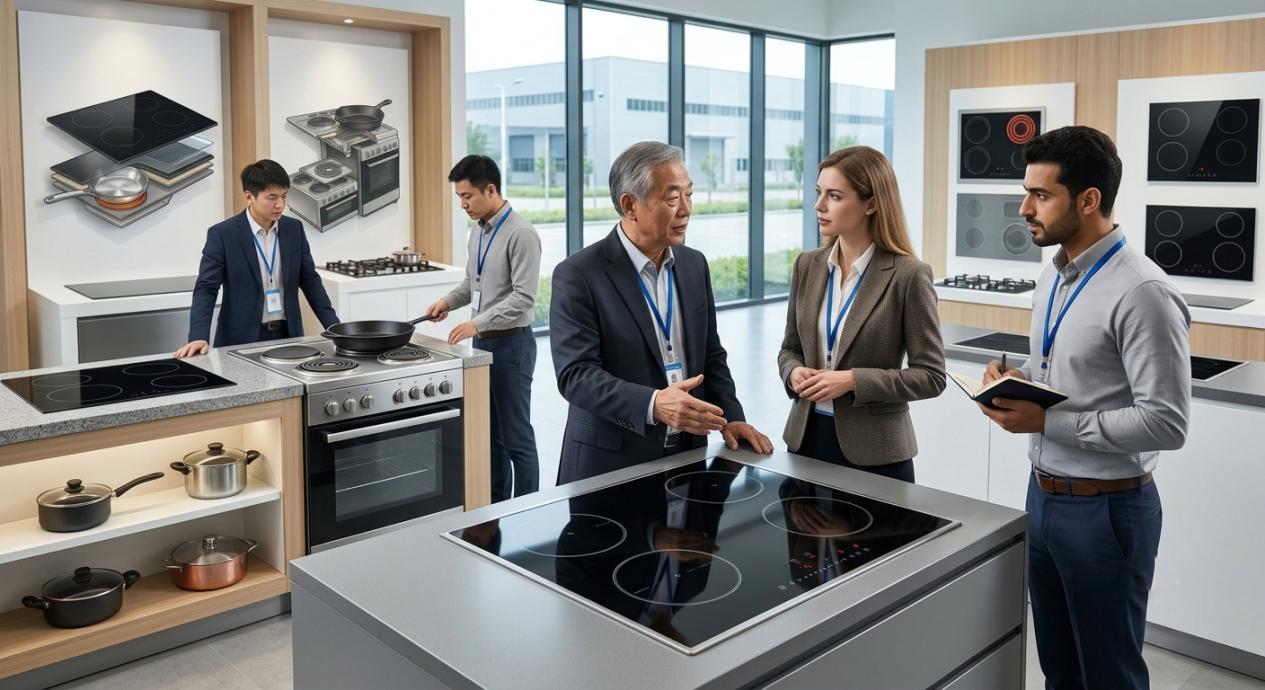
You do not have to choose only one technology. The most practical approach is a dual portfolio. A premium line of induction cookers targets high-end residential and modern kitchen projects. A value line of solid plate cookers covers rental housing, budget projects, student accommodation and hospitality segments that need robust, low-maintenance equipment.
A diversified product portfolio allows distributors to serve different customer segments instead of competing only on price or efficiency. Carrying both ranges reduces the risk of missing demand in either the premium or value channel and strengthens your position as a reliable electric cooking solution provider.
Choosing the Right Electric Cooker Depends on More Than Energy Efficiency
Induction leads in energy efficiency and cooking speed. Solid plate remains valuable for markets where affordability, durability and simple maintenance matter more. The better commercial decision is the one that matches the technology to local electricity prices, cookware habits, service infrastructure and buyer expectations.
This is why choosing the right supplier is as important as choosing the right technology. A reliable electric cooker supplier should help distributors choose the right product mix instead of promoting only one technology. CHEFF supports wholesalers, distributors and project buyers with different electric cooking solutions based on market requirements. The goal is to help you select the combination that delivers the best long-term results for your customers and your business.
FAQ
Q1. Is induction more energy efficient than solid plate?
Yes. Induction typically converts a higher percentage of electricity into useful heat because energy is generated directly in the cookware rather than transferred through a heating plate.
Q2. How much electricity does a solid plate cooker use?
As a simple example, a 2000 W solid plate cooker used one hour per day consumes roughly 730 kWh per year before adjusting for real cooking habits and residual heat. Actual figures vary with power setting and usage patterns.
Q3. Is induction cheaper to run than solid plate?
Generally yes, because of higher efficiency and faster heat-up times. The size of the saving depends on local electricity rates and how often the cooker is used.
Q4. Does induction always save money in the long term?
Not always. Higher purchase price, cookware replacement costs and maintenance complexity can offset energy savings, especially in low-tariff markets or regions with limited service support.
Q5. Why do some customers prefer solid plate cookers?
They accept almost any cookware, have simpler construction, are usually less expensive to buy and easier to repair. In many markets these practical advantages outweigh the efficiency difference.
Q6. Why do distributors still buy solid plate cookers?
Because total cost of ownership, customer acceptance and after-sales risk often favour solid plate models in price-sensitive and service-constrained markets.
Q7. What is the biggest advantage of solid plate cookers for distributors?
Lower purchase cost, simpler maintenance and universal cookware compatibility. These factors reduce market-entry barriers, warranty pressure and customer adoption friction in many wholesale channels.
Q8. Can solid plate cookers be a better choice than induction?
Yes. In markets where purchase price, cookware compatibility and easy maintenance are more important than maximum energy efficiency, solid plate cookers may provide better overall value for both end users and distributors.
Q9. What is the difference between induction and solid plate electricity consumption?
Induction generally uses less electricity because it transfers heat directly to cookware, while solid plate cookers lose more heat through the heating element and cooking surface. However, actual savings depend on usage patterns, electricity prices and product positioning.